

If you’re interested in adding real, literally growing assets to your portfolio, timberland investment funds can do just that. This article explores what timberland investment funds are, some of their main pros and cons, consider whether they’re actually good for the environment, and detail some practical ways investors can add timber to their portfolios.
What are timberland investment funds?
Timberland investment funds allow investors to own forests and forest-product companies without buying physical acreage themselves. Investor access typically comes through timber-focused ETFs that hold forestry-related stocks or through publicly traded timber REITs that own and manage timberland. Unlike commodities, timberland is a biological natural resource. As the trees grow over time, returns can come from moves in the price of timber, land value appreciation, and income from timber harvests.
Key terms:
Exchange-Traded Funds (ETFs) are funds which hold a collection of assets (e.g. stocks, bonds, commodities, etc.), and investors can buy or sell shares in the ETF on exchanges throughout the trading day just like stocks.
Real Estate Investment Trust (REIT) is a company that owns or invests in income-producing real estate and pays out some of those earnings to shareholders as dividends. In the case of timber REITs, the real estate consists of timberland managed for commercial wood production.
Advantages of timberland investment funds
- Diversification: Timber prices are shaped by a distinctive mix of supply-and-demand dynamics, long biological growth cycles, and environmental factors that set them apart from other commodities.
- Inflation hedge: Timber and wood-product prices have historically shown a correlation with inflation, which can help portfolios rise with inflation over the long term.
- Recurring income: Timber REITs typically pay dividends at regular intervals, with much of the cash flow coming from timber harvesting and other forestry-related operations.
- Intrinsic value: Owning timberland, either directly or via REITs, means owning assets with intrinsic value in the real world (land and standing timber). Trees can also take decades to mature, making them a long-term store of value.
Disadvantages
- Cyclical market: Timber and lumber prices can swing with house prices, construction activity, and trade policy (tariffs in particular).
- Liquidity risk: As timber ETFs and REITs have less assets under management compared to larger ETFs (e.g. those that track large indexes like the S&P 500) and are traded less frequently than larger ETFs too, it can be harder to cash out quickly.
- Operational risks: As they are assets that physically exist in the real world, they can be affected by wildfires and other natural disasters.
- Sustainability: “Sustainable” forestry varies in practice, and not all timber-related investments are always green. It’s important to distinguish between those with good environmental practices and those ruthlessly profiting from the logging of ancient forests.
Timberland investment funds
- Invesco MSCI Global Timber ETF is a fund which invests in a variety of companies in both developed and emerging markets engaged in the ownership and management of timberland and the production of products using timber as raw materials. This ETF trades on the New York Stock Exchange with the ticker CUT and is available through a variety of brokerages.
- Weyerhaeuser Company is one of the largest timberland REITs. It’s publicly traded on the New York Stock Exchange with the ticker WY, and operates as a vertically integrated land-and-timber business, paying out regular dividends to shareholders, and owns millions of acres of timberland across the United States.
- Rayonier is also a timber REIT trading on the New York Stock Exchange, with the ticker RYN. Rayonier was founded in 1926 in Washington state (today headquartered in Florida). It has sizable land holdings with approximately 2.5 million acres in some of the most productive softwood timber growing regions in the United States and New Zealand.
- PotlatchDeltic is a timber REIT trading on the NASDAQ with the ticker PCH. PotlatchDeltic owns approximately 2.1 million acres of timberland across the United States including the states of Alabama, Georgia, Idaho, and Louisiana. They also operate manufacturing facilities that produce lumber and plywood.
Are timberland investment funds good for the environment?
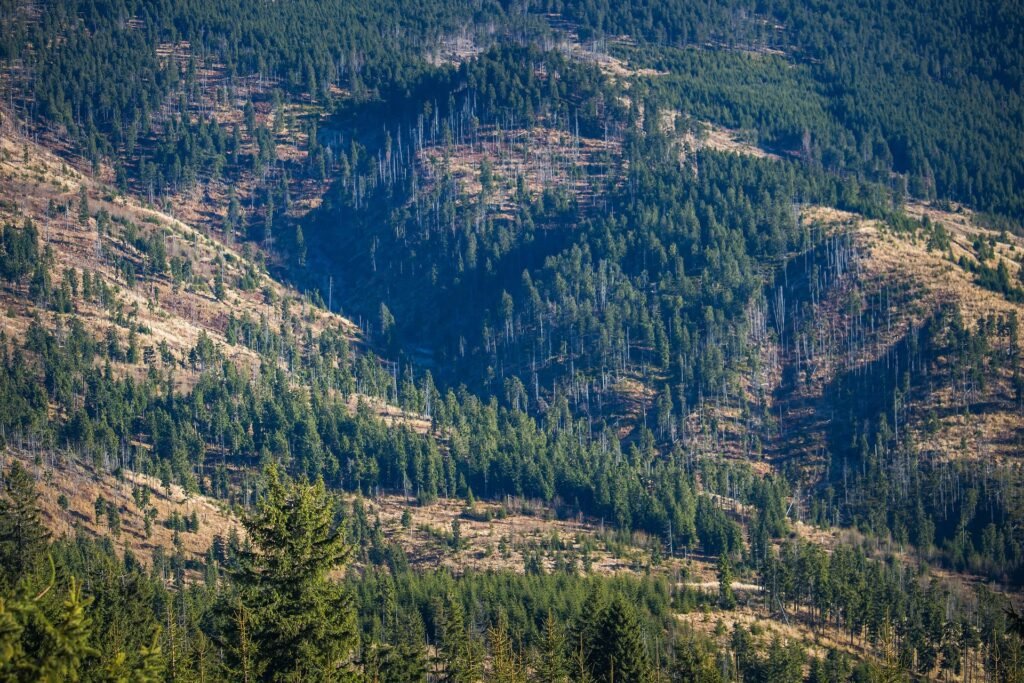
Well-managed timberland can be a climate ally. Long-rotation forests store carbon in trees and soil, and timber used in durable construction substitutes for carbon-intensive materials such as steel and concrete. Many REITs and funds now publish sustainability reports, and pursue third-party forestry certifications as well as regenerative practices.
However, timberland investment is not automatically green. Intensive short-rotation harvesting, conversion of natural forests into plantations, or weak protections for biodiversity can damage the environment. The real environmental impact depends on how the timberland is managed, its impact on local ecosystems, and the regulatory framework operating in that location.
Conclusion
Timberland can be a good way to diversify a portfolio, and its income-and-growth profile can also make it attractive. However, timberland investments can also be cyclical. It’s notable how many prices collapsed significantly following the 2008 financial crisis, showing how prices can fluctuate significantly when the broader real estate market and construction activity are affected. Money really can grow on trees, but rising prices are not guaranteed under all economic conditions.
Disclaimer: The purpose of this website is education and financial journalism. It is not a recommendation or personalized financial advice. Your personal circumstances have not been taken into account, and this website is not a substitute for consulting a qualified financial advisor. All images are for illustrative purposes only. Past performance is not indicative of future returns.